by Jodie | Sep 30, 2016 | Australian Economy, Budget, Economy, Self Managed Superannuation Funds, Superannuation
On 27 September 2016 the Government released another round of draft legislation implementing a number of the changes to superannuation it announced in the 2016 Federal Budget.
Many of these changes will apply from 1 July 2017 so it might be sensible to for you to start thinking of how your superannuation will be impacted by the changes now and whether you might need to change any of your SMSF’s arrangements.
Included in the latest legislation were amendments relating to:
• Implementing the Government’s $1.6 million transfer balance cap, which places a limit on the amount an individual can hold in the tax-free retirement phase from 1 July 2017.
• Lowering the concessional contributions cap to $25,000 per year for all taxpayers from 1 July 2017.
• Reducing the income threshold at which individuals are required to pay an additional 15 per cent contributions tax, from $300,000 per year to $250,000.
• Providing greater flexibility for those with broken work patterns by allowing individuals with balances of less than $500,000 to ‘carry forward’ unused concessional cap space for up to five years.
• Removing the tax-free treatment of assets that support a transition to retirement income stream.
Some of these changes may require you to adjust your investment, contribution, pension and estate planning strategies going forward.
This will most likely be the case if you have a superannuation balance of over or close to $1.6 million, were planning on making significant contributions to superannuation in the next few years, are a high income earner or have a transition to retirement pension in place now.
How can we help?
If you are concerned that the Government’s changes to superannuation are going to affect you, please feel free to give me a call at the office on 07 5593 0855 to arrange a time to meet so that we can discuss your particular requirements in more detail.
by Jodie | Sep 28, 2016 | Insurance & Protection
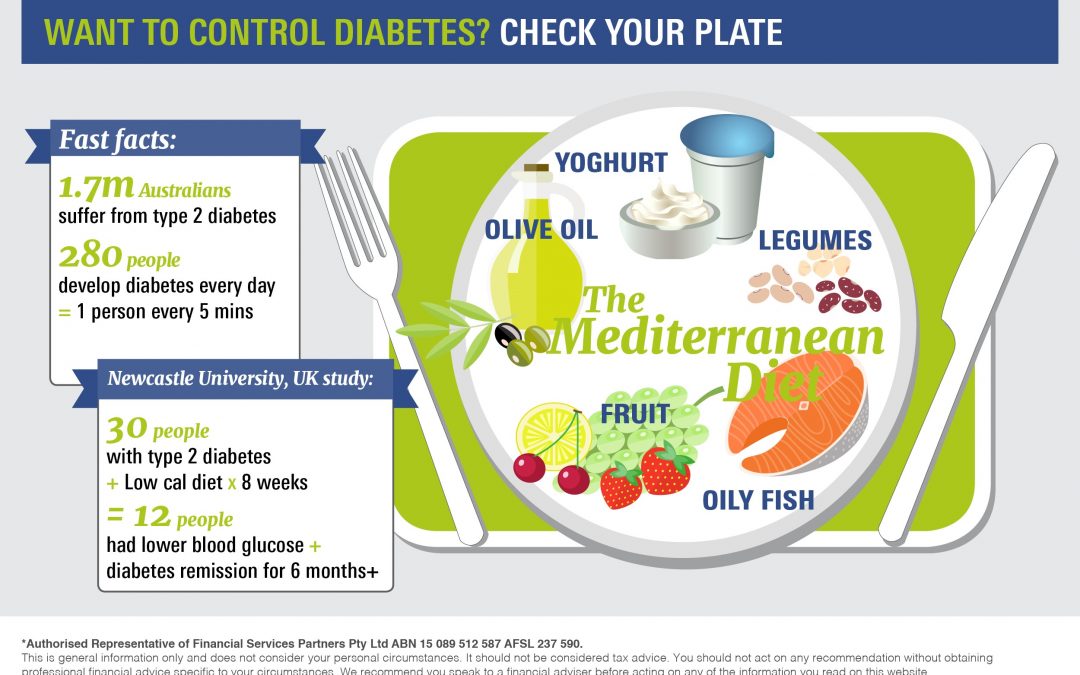
What if you could reverse diabetes with chickpeas, fish and olive oil? A new study from Newcastle University links a very-low-calorie diet with the cessation of type 2 diabetes.
Type 2 diabetes is a progressive condition, at first managed by diet or surgery, and then by medication or insulin injections. But a new study indicates this doesn’t have to be the case.
A study conducted in March this year by Newcastle University in the United Kingdom placed 30 individuals with type 2 diabetes on a very-low-calorie diet for eight weeks and stopped all diabetes medication and insulin injections. A dozen participants experienced lower blood glucose levels and their diabetes went into remission for at least six months. The research team believes major weight loss can return insulin levels to normal.
While research needs to continue, the study provides hope that type 2 diabetes may not be a lifelong condition – and that’s great news for the 1.7 million Australians who suffer from it.
Inspired by the study, documentary-maker Dr Michael Mosley has suggested that the Mediterranean diet may help control diabetes. The diet is mainly vegetarian, with a few servings of oily fish a week. Olive oil is the primary added fat, and the diet also includes fresh fruit, yoghurt and legumes.
Researchers around the world have been studying the Mediterranean diet due to its remarkable effects on health. A recent study presented at the American Society of Clinical Oncology meeting in Chicago found the diet could help prevent the return of breast cancer. Other studies have suggested it can reduce the risk of heart disease and dementia.
According to Diabetes Australia, 280 people develop diabetes every day. That’s one person every five minutes, and makes it the fastest growing chronic condition in Australia. If you suffer from diabetes, would like to lose weight or would like to improve your overall health, the Mediterranean diet may be for you. But always check with your healthcare professional first.
Diabetes can affect your ability to be covered by insurance due to the long term effects of the condition so early diagnosis and management is vital.

by Jodie | Sep 22, 2016 | Finances, Investments, Money, Wealth
When you donate to charity, your gifts may be a tax deductible donation that can boost your tax refund.
There are many charities in Australia that rely on donations to continue their good work and nine out of 10 of us give to charity each year*. Here we provide a guide to making your gift go further and claiming your donation back at tax time.
What are some ways to give?
According to consumer group Choice, some great ways to give to charity are to give directly or to volunteer. More than 30% of Australia’s adult population volunteer with various not-for-profit organisations, giving an average of 56 hours per year. If you are interested in volunteering some of your time, visit the Go Volunteer website to find out about opportunities in your area.
Less effective ways to give are charity dinners and balls, as the cost of the venue and catering can eat into your donation. Charity telemarketers also take a cut of the money you give.
Tips for claiming charitable donations
Charitable donations are generally tax-deductible but before claiming any donations on your tax return, here are a few tips:
- The charity must be classified as a deductible gift recipient (DGR). To check, visit the Australian Business Register.
- To qualify for a tax refund, your gift must be greater than $2. Keep receipts for any donations you make.
- The gift must truly be a gift – a voluntary transfer of money where you receive no benefit or advantage. You cannot claim items such as raffle tickets; items such as pens or chocolate
or membership fees.
Two favourite charities that Wealth Planning Partners are proud to support financially, and with our time, are The Hunger Project, who aim to eradicate chronic, persistent hunger by 2030 and Hands Across the Water, helping orphaned and disadvantaged children in Thailand.
*Charity donations guide, Choice, September 2014
by Jodie | Sep 22, 2016 | Advisers, Finances, Insurance & Protection, Money
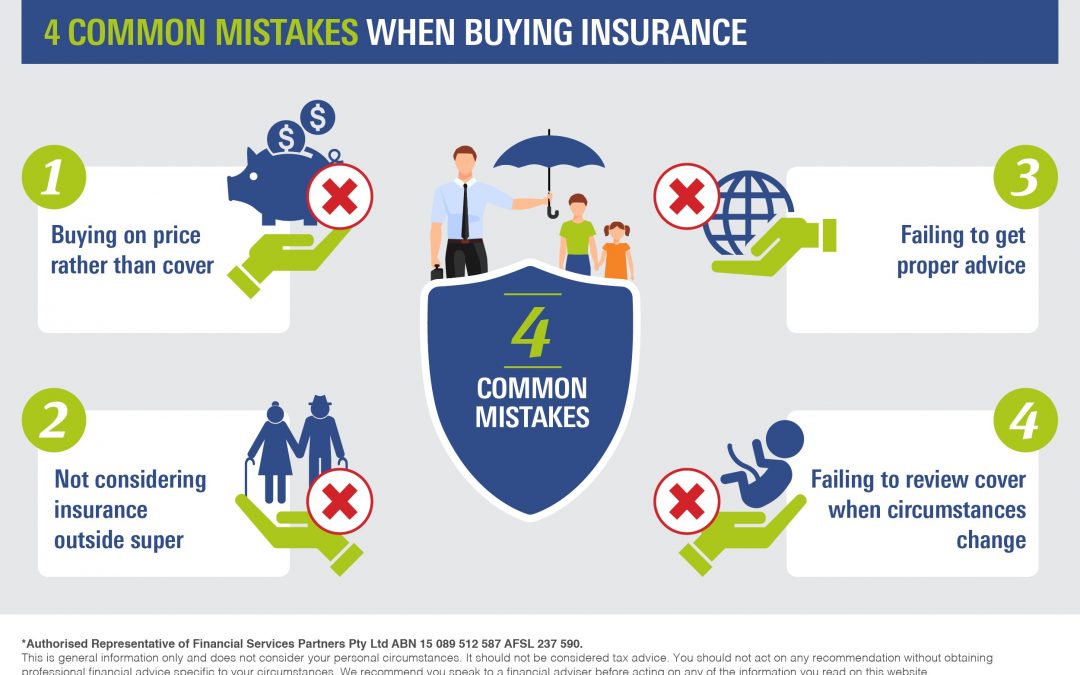
If your life insurance policy is in a drawer gathering dust, your family could be in for a nasty shock in the event of a claim. Here we outline some pitfalls to avoid when taking out cover.
1. Buying on price rather than cover
No-one wants to pay too much for cover but the purpose of buying life insurance is to ensure your family won’t be left to fend for themselves in the event of your death.
Cheap policies can be riddled with potential issues, so read the fine print and look into the capacity
of the insurer to pay, policy exclusions and dispute handling processes.
2. Not considering insurance outside super
Many people make the mistake of thinking that life insurance cover through super will be enough. Most super funds provide a default level of cover but this is often well below the level required.
In some cases, people could be caught unaware that their insurance cover had lapsed if and when they changed jobs and switched out of the fund. However, on the plus side, since the introduction
of Choice of Fund, it is easier to carry over and elect to use your own superannuation fund when going into a new job. An individual’s insurance cover within their super fund remains intact as long
as they remain a member of that fund.
When it comes to insurance within superannuation it’s also important to remember that premiums
are paid from what is effectively your retirement savings, which can impact your overall super balance on retirement and when you begin drawing down on your savings.
3. Failing to get proper advice
Life insurance policies are easy to obtain these days and it can be tempting to buy policies online
or from a teleprovider. However, policies that are quick and simple to obtain may be declined at claim time for reasons such as non-disclosure, exclusions or hidden clauses.
Sitting down with a qualified adviser means you can benefit from unbiased advice on a broad range of policies that can be tailored to your individual requirements. The adviser will also discuss issues you might not have thought of- for example will your insurance policy be owned by you, your spouse, both of you, your super fund or a trust or corporate entity?
4. Failing to review cover when circumstances change
There are certain key events in life when it is imperative to take a fresh look at your insurance coverage.
Have you married or divorced or has your spouse passed away since you last reviewed your policy? Have you become a parent or have your kids left home? Have there been any changes in your financial circumstances such as an increase in income, more debt or paying off a mortgage?
All these are factors to consider when determining the level of your cover.
Summary
No-one wants their families to be left high and dry in the event of their death. Taking the time
to consider your life insurance today may be your greatest gift to your loved ones tomorrow.
by Jodie | Sep 22, 2016 | Advisers, Women
Wealth Planning Partners are pleased to announce that their Director Amanda Cassar has been named a finalist in the Female Excellence in Advice Awards for 2016.
CEO of the Association of Financial Advisers (AFA) Brad Fox, said the ability of this Award to attract so many women of such high calibre is a great indication of the industry’s progress in generating positive change for the future.
“Female advisers play a vital role in our industry in providing Australians with better access and more choice over who they partner with on their financial journeys. As a result, the Australian advice industry continues to get better, enabling it to provide great advice to more Australians.”
The Award criteria include assessment of the candidates’ contributions to financial literacy in the community and/or campaigns targeted specifically at helping female clients take control of their financial lives.
TAL, who are long term sponsors of the Award, General Manager of Retail Distribution, Niall McConville said the Award continued to attract and showcase some of the extraordinary female talent in the industry.
The winner for the AFA Female Excellence in Advice Award will be announced at the AFA National Conference in Canberra from 5-7 October 2016.
We would like to wish Amanda and all the finalists the very best for the announcement of the award winner and note that it’s the clients who are the real winners when such passionate ladies are their to assist with their financial needs..