
by Jodie | May 11, 2017 | Advisers, Australian Economy, Budget, Finances, Retirement, Superannuation
As you’re not doubt aware, the Federal Government announced it’s 2017 Budget this week and one of the surprise outcomes was the Downsizing Contribution for those looking to move out of a larger family home. Here’s a little more about how that works…
Downsizing contribution
People aged 65 or over will be able to make a non-concessional contribution to their superannuation of up to $300,000 each from the proceeds of selling their principal residence.
- Work test does not apply
- Residence must be held for a minimum of 10 years
- Total superannuation balance restrictions of $1,600,000 do not apply
- Restrictions eased on people aged 75 or over.
Downsizing contribution Case Study
John is 75 and Jane is 69 and they both have retirement income streams. They sell the home they have lived in for more than 10 years to downsize and the proceeds are $2,000,000.
George has room under the $1.6 million transfer balance cap. He can make a non-concessional contribution of $300,000 to superannuation and may choose to use the contributed proceeds to start a new account-based pension.
Jane has already used her transfer balance cap. She can make a non-concessional contribution of $300,000 to superannuation. As she has no room under her cap she cannot start a new pension with the contributed proceeds.
It’s worth having a chat with your Adviser to see if this is the best strategy for you, as you may lose Centrelink entitlements, depending on your new circumstances.

by Jodie | May 1, 2017 | Budget, Centrelink, Finances
The chances are you dutifully file your tax returns every year but are you making the most of your government entitlements? In this article,
we guide you through some key entitlements available for families.
Are you confused about your government entitlements? The good news is the recent overhaul of the Department of Human services no longer means lengthy waits in government office queues or listening to hold music while trying to organise your childcare rebate.
With automated payments and the user-friendly MyGov website, there has never been a better time to take a fresh look at your entitlements.
The birth of a child
Taking time out to care for a newborn can be expensive. However, since January 2011 primary carers now have access to government-funded parental leave payments, which are currently made for up to 18 weeks. There is also a 2-week payment available to eligible dads or partners assisting with a newborn.
Assistance with childcare
To encourage parents with young children to remain in the workforce, there are some great benefits on offer to working parents.
If you have children attending approved childcare and meet the income test (currently below $160,308 for families with two children), you may be entitled to the Child Care Benefit to help with the cost of daycare, vacation care or before and after-school care.
Higher income families may still claim the Child Care Rebate, which covers up to 50% of out “of pocket childcare expenses, up to an annual limit of $7,500.
Assistance for low to medium income families
Single parents and low to medium-income families can take advantage of a range of tax breaks and payments that can make raising a family more affordable. These include:
- The Single Income Family Supplement, which provides an annual payment of up to $300 to
help eligible households. The main income earner must earn between $68,000 and $150,000 and any secondary income earner below $18,000.
- The Parenting Payment for single parents with children under 8 or parents with partners with children under 6 who meet certain income tests.
- Family Tax Benefit for lower income families with dependent children under 20 (which includes grandparents assisting with childcare).
Summary
We have outlined just a few of the benefits that can help with the cost of raising a family.
To find out more about your entitlements, visit the Department of Human Services website.
by Jodie | Apr 18, 2017 | Budgeting, Debt Management, Finances, Insurance & Protection, Investments, Money, Retirement
From wills to long-term budgeting, there’s a lot to think about when making your retirement to-do list. Here’s some tips to make sure you’ve ticked all the boxes.
1. Check your will
Without a valid will, an administrator will be appointed to manage your estate, which may cause your family plenty of problems. To save them the stress, ask a solicitor to draw it up for you and make sure you and two witnesses sign it.
2. Plan your estate
Think of your estate plan as your family’s stress-free action plan that they can turn to for guidance when you pass away. It should cover all of your documents, contacts, debts, bills and assets so your family can easily figure out what to do with them.
3. Budget for the long haul
Australians are living longer than ever – which means your retirement savings also need to last longer. Create a long-term budget that will help you live the lifestyle you want – and don’t forget about healthcare costs. Then comes the most important part of a budget – sticking to it.
4. Invest in your future
From boosting your superannuation to investing in shares, understanding your investment options can make a huge difference to your retirement savings. When you start investing – and you should start early – make sure you have a mix of investments to spread your risk.
5. Be wary of scams
Investment scams are on the rise in Australia, with perpetrators directly targeting retirees to access their superannuation funds. Protect yourself by never giving out your financial details over the phone or by email. And be suspicious of anything that sounds too good to be true.
6. Start thinking about insurance
Many insurance policies expire at a certain age, leaving you without cover. And if yours comes from your superannuation fund, it could be eroding your savings. From age-based insurance policies to products that cover funeral expenses, you should seek professional financial advice to develop a plan that is appropriate for you as you enter retirement.
by Jodie | Apr 2, 2017 | Finances, Investments, Retirement, Savings, Superannuation, Wealth
The Government has legislated changes to the Age Pension rules from 1 January 2017, which it estimates will see 300,000 Australians lose all or part of their pension entitlements.1
If you are retired or about to retire, some careful planning now may put you in shape to access at least a part Age Pension. Here we outline some strategies to consider.
Building up the super of the younger member of a couple
If you are retired and have a spouse who has not reached Age Pension qualifying age, making contributions to your spouse’s super account may be beneficial. This is because super in the accumulation stage is not counted towards the Age Pension assets or income tests until the member reaches Age Pension qualifying age or begins an account-based pension.
Gifting
Gifting money (for example to a family member or charity) can help to reduce your assessable assets. The Government has set a limit of $10,000 per financial year for a single person or a couple, limited to a total of $30,000 over a five-year period. If you are planning to gift more than the allowable limits, check the rules here as penalties may apply.
Pre-paying a funeral plan
While it is not something that everyone would like to consider, pre-paying for a burial plot or funeral expenses can make good financial sense. As well as saving your family expense when you die, prepaid funeral plans and burial plots are not assessable assets for Age Pension purposes.
Using certain income streams
Certain annuities are assessed more leniently under the Age Pension rules than other investments, which may help you to achieve a higher level of Age Pension.
When purchasing a term annuity, you can select the proportion of capital (residual capital value) you would like returned to you at the end of the investment term. Annuities with a residual capital value of less than 100% are generally assessed favourably under the income and assets tests.
Speak to your adviser for more details as the rules differ depending on when an income stream was commenced, its term and your life expectancy.
Summary
If you are concerned about how the upcoming changes to the Age Pension rules will affect you, arrange a meeting with your financial planner who can help you to structure your income and assets to make the most of your entitlements.
Source:
1. http://www.superguide.com.au/how-super-works/300000-retired-australians-to-lose-some-or-all-age-pension-entitlements

by Jodie | Mar 16, 2017 | Advisers, Insurance & Protection, Retirement
You’re retired, the house is paid off and the children are self-sufficient, – it may be time to review your life insurance?
Policies expire
People take out life insurance while they are working to protect their dependants if they die prematurely.
Life insurance policies, including income protection, trauma, and total and permanent disability (TPD) insurance, generally expire when you reach a certain age, even if you are still working. So, let’s consider some of the insurance products you may have and see how long they generally last.
Insurance options
Term life insurance is a popular policy option. Beneficiaries receive a lump-sum payment if the policy holder dies or suffers a terminal illness and the usual expiry age is 99.
TPD insurance is paid in a lump sum if an accident or illness prevents the policyholder from earning an income. The usual expiry age for this type of insurance is 65.
Trauma insurance covers a major illness or injury, such as a stroke or car accident. It covers specific events and is paid out in a lump sum that can be used for any purpose, such as living or medical expenses. The usual expiry age for this type of insurance is 70.
Income protection insurance covers loss of income caused by accident or illness. Typically, these types of policies pay 75 per cent of the insured person’s income but there are many variations in their terms. The usual expiry age for this type of insurance is 70.
What about my super?
There are usually additional rules for policies held within a superannuation fund. Life insurance coverage through super usually ends at the age of 65.
When deciding whether to take out or continue your life insurance, you may wish to consider such things as any outstanding debts, including any mortgage repayments, as well as the needs of those you leave behind.
Nevertheless, each person’s circumstances are different and if you are unsure of what you need, talk to your financial adviser.
![Safeguarding your retirement plan]()
by Jodie | Mar 3, 2017 | Budgeting, Finances, Insurance & Protection, Superannuation, Wealth
From wills to long-term budgeting, there’s a lot to think about when making your retirement to-do list. Here’s some top tips to make sure you’ve ticked all the boxes.

1. Check your Will and Power of Attorney documents
Without a valid will, an administrator will be appointed to manage your estate, which may cause your family plenty of problems. To save them stress, ask a solicitor to draw it up for you and make sure you and two witnesses sign it. Powers of Attorney protect you whilst you live, but can’t make your own decisions. Pick the person you trust most to make the big decisions in your life.
2. Plan your estate
Think of your estate plan as your family’s stress-free action plan that they can turn to for guidance when you pass away. It should cover all of your documents, contacts, debts, bills and assets so your family can easily figure out what to do with them. And don’t just put it all on paper, communicate with your family now, and let them know what you’d like so everyone is clear. It may save problems later!
3. Budget for the long haul
Australians are living longer than ever – which means your retirement savings also need to last longer. Create a long-term budget that will help you live the lifestyle you want – and don’t forget about healthcare costs. Then comes the most important part of a budget – sticking to it. Think of it as the plan you’ll follow for future spending.
4. Invest in your future
From boosting your superannuation to investing in shares and property, understanding your investment options can make a huge difference to your retirement savings. When you start investing – the earlier the better – make sure you have a mix of investments to spread your risk. And invest in yourself! Learn and partner with a professional to maximise your options.
5. Be wary of scams
Investment scams are on the rise in Australia, with perpetrators directly targeting retirees to access their superannuation funds. Protect yourself by never giving out your financial details over the phone or by email. And be suspicious of anything that sounds too good to be true. You know it probably is!
6. Start thinking about insurance
Many insurance policies expire at a certain age, leaving you without cover. And if yours comes from your superannuation fund, it could be eroding your savings. From age-based insurance policies to products that cover funeral expenses, you should seek professional financial advice to develop a plan that is appropriate for you as you enter retirement, so touch base with your planner sooner rather than later.

by Jodie | Feb 27, 2017 | Australian Economy, Budget, Economy, Superannuation
The changes to super and tax laws proposed in this year’s federal budget, then revised and adjusted by the government in September, have been passed through Parliament and are mostly due to take effect from July 1, 2017. That means that you have until July to consider if there is any action you should take to make the most of current super rules or to comply with the upcoming changes.
We take a look at some of the key changes in the table below.
Significant super reforms
| Now |
New* |
| No limit on funds moved into tax-free pension phase. |
$1.6 million transfer balance cap on super transferred to the tax-free retirement income phase. |
| You can contribute $180,000 of after-tax earnings to super each year (or $540,000 for those eligible to bring forward two years of contributions). |
Reduction in annual after-tax contributions cap to $100,000 (or $300,000 if bringing two years of contributions forward, if eligible). Clients with balances of $1.6 million or more, just before the start of the financial year, cannot make after-tax contributions. |
| Annual concessional (before-tax) contributions limit of $30,000 (or $35,000 if aged 50 or over by June 30, 2017). |
Reduction in the annual concessional (before–tax) contributions cap to $25,000. This applies regardless of age. |
| Unused concessional contributions caps are lost. |
Catch-up concessional contributions may be available for those with balances less than $500,000 just before the start of the financial year. |
| If income from employment is less than 10% of total income, you can claim a tax deduction for personal super contributions. |
Clients under age 65; or age 65-74 who satisfy the work test, can claim a tax deduction for personal super contributions. |
| Additional 15% tax on certain concessional contributions if your adjusted income exceeds $300,000. |
Additional 15% tax on certain concessional contributions, if your adjusted income exceeds $250,000. |
| Earnings on transition-to-retirement super pensions are tax free. |
No earnings tax exemption on transition-to-retirement super pensions. Earnings will be taxed at up to 15%. |
| Anti-detriment payments may apply on certain lump sum death benefits (generally a notional refund of contributions tax to be paid on death). |
No anti-detriment payments on lump sum super death benefits (no refund of contributions tax paid on death). |
| Offset for contributions to spouse’s super (if spouse earns under $13,800). |
Offset for contributions to spouse’s super (if spouse earns under $40,000). |
| The ‘low-income super contribution’ refunds tax (up to $500) on concessional contributions for those earning $37,000 or less. |
Introduction of the low-income super tax offset (effectively a continuation of the low income super contribution). |
*These measures start July 1, 2017, except for the catch-up concessional contribution measure which starts July 1, 2018.
If you are concerned about how you may be impacted, now is the time to talk to your financial adviser so you have time to review your superannuation and retirement plan, before the changes take effect.
If you enjoyed this article, feel free to share it with your friends and family.
Want to know more? To find out how we could help you, contact our office today and make an appointment with one of our professional financial advisers on 07 5593 0855.

by Jodie | Feb 22, 2017 | In The Media
There is a dizzying array of types of insurance available in Australia, although the average person probably won’t be needing aircraft or defamation insurance. But like death and taxes, the majority of people won’t be able to avoid getting at least some of the basic types of insurance such as motor vehicle, house and contents and health cover.
by Jodie | Feb 17, 2017 | Business, Debt Management, Insurance & Protection, Savings
Protecting yourself from frivolous creditors and lawsuits is becoming an increasingly common concern. Here we outline some of the ways you can insulate your assets.
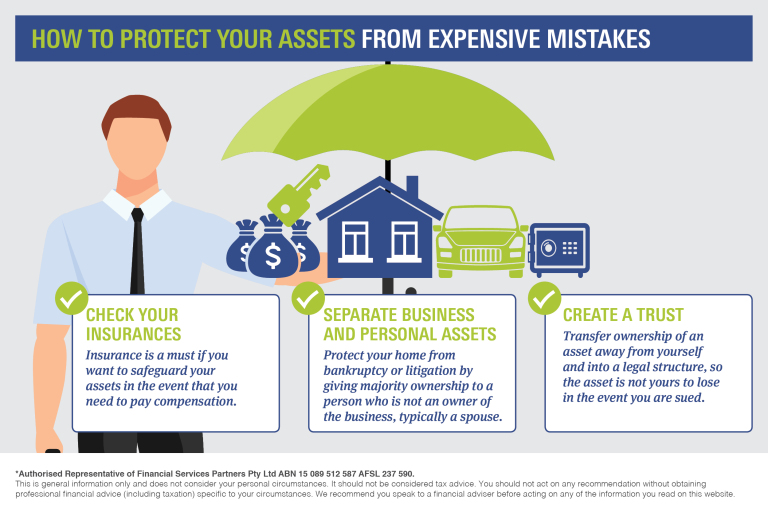
Check your insurances
Liability insurance is a must if you want to safeguard your assets in the event that you need to pay compensation. Lawsuits can arise for a range of reasons – from personal injury to financial loss resulting from any products or services you provide.
You can choose from three key types of cover – public liability insurance, professional indemnity insurance and product liability insurance. Seek advice from your financial adviser or insurance broker to determine which, if any, of these are suitable for you.
Separate business and personal assets
If you are a business owner and your family home is held in your name, it may be at risk from bankruptcy or litigation procedures.
One way to protect your home is to give majority ownership of the home to a person who is not an owner of the business, typically a spouse. The business owner generally retains some interest in the home, however, to ensure the asset is not dealt with without his or her authority. It is also important that the spouse does not having any dealings in the business, for example guaranteeing loans. You should also know that the trustee in bankruptcy will consider other factors to determine the bankrupt’s interest in the house and if you transfer your home to your spouse for no consideration or for less than its value, before bankruptcy, the trustee in bankruptcy can in some cases reverse the transaction.
Create a trust
Trusts can be beneficial asset protection strategies, as you are transferring ownership of an asset away from yourself and into a legal structure, so the asset is not yours to lose in the event you are sued.
Anthony Lieu, Lawyer at Legal Vision, says trusts also provide a degree of flexibility.
“Just as each family is different, each discretionary or family trust is also different. Trusts generally take their rules and operation from the trust deed, so each trust will have to abide by a different set of rules,” Lieu says.
Summary
Structuring your assets the right way is one of the most important things you can do to protect your hard-earned wealth. As these strategies can be complex, always seek the help of a qualified professional such as your financial planner, lawyer or accountant.
![Safeguarding your retirement plan]()
by Jodie | Feb 13, 2017 | Finances, Insurance & Protection, Investments, Money, Wealth
Creating a valid will is one of the most important things you can do to protect your loved ones. Here we explain how to go about it.

Seek legal advice
While DIY will kits can seem like an easy and inexpensive way to make a will, they can be fraught with pitfalls.
Your affairs are probably more complex than you think – your family home, business assets, super, investments and belongings. Some of things are covered by a will and some aren’t! Having a properly drawn up will helps to determine who gets what and can save your family time and stress when you are gone.
Your lawyer or financial planner will also be able to provide insights into how to best structure your will, both to protect assets and to minimise tax. Examples include setting up a testamentary trust to provide for minors or protecting your estate from creditors and making binding nominations for your superannuation funds.
Safeguard your children’s future
Probably one of the most important reasons to make a will is to ensure any dependent children are well cared for should the worst happen.
Sydney wills, probate and estate specialist, Graeme Heckenburg of Heckenberg Lawyers, says generally parents should make separate rather than joint wills, as they are likely to die at different times.
Heckenburg says a will should also appoint a guardian to take care of the day to day living and housing arrangements for the children and a trustee to execute the will and make any financial decisions. This can be one person or two different people.
“If you don’t appoint a guardian and there are young children, ultimately the decision will be made by the Guardianship Tribunal [in NSW]. If the guardianship is contested, the matter could even end up in the Supreme Court,” he says.
Keep your will updated
Once you have made a will, don’t leave it in a drawer gathering dust. Circumstances change over time change, so ensure your will reflects your current situation, particularly if your spouse has died, you have married or divorced or you have become a parent.