
by Jodie | Jan 13, 2020 | Economy, Money, Retirement, Superannuation
Did you know there are over 12[1] million Australians with a single superannuation account? There is also $13.8[2] billion in ‘lost super’. Is some of that yours?
Find it
Moved house over the years? Changed jobs during your career? Don’t know where your teenage self stashed your super? Pretty sure you’ve lost track of some accounts along the way? It’s easy enough to track it down. If you have a MyGov account, log in and link to the ATO. Then, you’ll be able to find superannuation linked to your name and tax file number easily enough here.
Consider Combining it
So, you want to save on fees, reduce your paperwork, keep track of your hard earned money, and grow your retirement fund? But, ensure you seek professional financial advice first to make sure combining is beneficial for you. However, there may be some drawbacks to combining if your health has changed and you have insurances in your existing fund. Your Advisers at Wealth Planning Partners can assist with advice on combining superannuation funds.
Ask your financial adviser
Many websites offer to help find and combine your super, including MyGov. It is quick, easy and free. You can ask your financial adviser for help; check with your existing superannuation provider or the Australian Tax Office. If you want to do a bit of research yourself, check out the ASIC MoneySmart website too.
Grow it
A professional financial adviser can help you find an appropriate superannuation fund that will grow your hard-earned funds. We can work out whether you are invested in line with your preferred risk profile. This can help manage the ‘sleep at night’ test in times of market movements. Also, Advisers can review the fees you are paying and check historical returns. And, we can help to ensure you have enough income for retirement. The sooner you nail it, the better!
Contact your Gold Coast financial planners at Wealth Planning Partners to find out more.
Source:
[1] https://www.ato.gov.au/About-ATO/Research-and-statistics/In-detail/Super-statistics/Super-accounts-data/Multiple-super-accounts-data/
[2] https://www.ato.gov.au/About-ATO/Research-and-statistics/In-detail/Super-statistics/Super-accounts-data/Lost-and-unclaimed-super-by-postcode/

by Jodie | Nov 6, 2019 | Finances, Money, Wealth
Here’s 4 ways to boost your income…
Want to break free from being asset rich and cash poor? Turns out, you’re not alone! Data from the ABS (Australian Bureau of Statistics) shows almost one-third of older Australians in low-income households were asset rich but cash poor.[1] Most of their wealth was tied up in illiquid assets. In particular the family home.
But, there’s no need to scrape by on so little. There are ways to try boost your income.
1. DOWNSIZE YOUR PROPERTY
Selling up and moving to a cheaper house may free up wealth to help fund retirement. But, do keep in mind that it might affect benefits if you’re receiving a Centrelink Age Pension. Some of the proceeds from the sale might be counted as assessable under the Assets Test. This could lead to a drastic cut in your pension if you suddenly acquire additional cash.
2. SUPPLEMENT YOUR INCOME
Getting a part-time job or cashing in on a hobby could boost your cash flow if you are retired . But remember that working when you have become eligible for an age pension may reduce your pension amount under the income test. It’s best to discuss with your adviser how you might optimise your retirement benefits while working part time.
3. RENT OUT YOUR PROPERTY
If you have extra space in your home, such as a spare room or two, you may consider renting it out, either full time or on a part-time basis. Or if you have another property, like a holiday home, you may look into listing it as a short-term student or holiday rental. This too could impact the tax you pay when you sell your home so you should seek advice on these strategies.
4. REVISIT YOUR INVESTMENTS
Have you invested in securities? With cash rates at an historical low, this may be a good time to meet with a financial adviser to review your portfolio. Your financial adviser may recommend strategies and ways to increase income and/or reduce your exposure to risk and volatility in the event of market movements.
UNDERSTAND THE RISKS and BREAK FREE
You don’t have to be trapped in a situation where you are always asset rich but cash poor. There are ways to boost your income, but keep in mind that some involve taking big risks. So seek financial advice to help you weigh your options and make decisions based on your on personal financial situation.
The Advisers at Wealth Planning Partners in Robina are ready to help you with financial advice tailored to your financial situation.
Note
[1] Australian Bureau of Statistics, March 2016, ‘Many older Australian households asset rich, income poor’, accessible at: https://www.abs.gov.au/ausstats/abs@.nsf/Lookup/by%20Subject/6523.0~2013-14~Media%20Release~Many%20older%20Australian%20households%20asset%20rich,%20income%20poor%20(Media%20Release)~40

by Jodie | Apr 5, 2019 | Aged Care, Australian Economy, Budget, Centrelink
The Federal Budget explains to all Australians how the Government intends to manage the country’s finances. It outlines their tax and spending plans. Not only during the next financial year but into the future as well. Just like a household budget, the Federal Budget forecasts revenue and expenses to determine whether there is a surplus or deficit.
It’s also a political statement setting out the Government’s intentions, priorities and new policy initiatives. So, how does the Federal Budget affect you?
This year’s Budget proposal
This year’s Federal Budget is an ‘election budget’ with future tax cuts for all Australians, especially low and middle income earners. Overall, there were minimal changes to super proposed in the Budget, with minor changes to super contributions for older Australians.
Superannuation
Superannuation contributions for older Australians
From 1 July 2020, there will be no work test for people aged 65 and 66 when making concessional and non-concessional contributions. Currently, you need to work at least 40 hours over a 30-day period to contribute.
Also, the three-year bring-forward for non-concessional contributions is proposed to be extended to people aged 65 and 66 which means they could contribute up to $300,000 in non-concessional and $25,000 concessional contributions in one year.
Spouse contributions
And, from 1 July 2020, you can continue to receive spouse contributions up to age 74, up from age 69, if the work test is met. This will help couples even up their super balances as they near retirement. Learn more about Spouse Contributions thanks to MoneySmart.
Protecting Your Super Package
In March 2019, the Protecting Your Super Package legislation passed. This means:
- if you have a super balance of below $6,000, administration and investment fees will be capped at 3%
- from 1 July 2019, you will no longer be charged an exit fee
- if your account has been inactive for 16 consecutive months your insurance cover will cease.
The proposal to ensure insurance is only offered on an opt-in basis for accounts with balances of less than $6,000 and new accounts belonging to members under the age of 25, did not pass into legislation. The Government will delay the start date for this measure until 1 October 2019.
Tax
Personal income tax cuts
The Government proposes the following personal income tax rates.
- From 1 July 2022, the top threshold of the 19% tax bracket will increase from $41,000 to $45,000. And, the low income tax offset (LITO) will increase from $645 to $700.
- And, from 1 July 2024, the 32.5% tax rate will reduce to 30%.
Proposed personal tax rates and thresholds
| Tax rate |
Current threshold |
Threshold from 1 July 2022 |
Threshold from 1 July 2024 |
| Nil |
0 – $18,200 |
0 – $18,200 |
0 – $18,200 |
| 19% |
$18,201 – $37,000 |
$18,201 – $45,000 |
$18,201 – $45,000 |
32.5% until 30 June 2024
30% from 1 July 2024 |
$37,001 – $90,000 |
$45,001 – $120,000 |
$45,001 – $200,000 |
| 37% |
$90,001 – $180,000 |
$120,001 – $180,000 |
– |
| 45% |
$180,000+ |
$180,000+ |
$200,000+ |
| Low and middle income tax offset (max) |
$1,080 |
– |
– |
| Low income tax offset (max) |
$445 |
$700 |
$700 |
Low and middle income tax offset
The low and middle income tax offset (LMITO) will increase for the 2018/19 to 2021/22 financial years. After this, LMITO is not available. The maximum LMITO will increase from $530 to $1,080.
Enhancements to the instant asset write-off
If you have a small or medium business, you can immediately deduct eligible assets costing less than $30,000. The assets must be first used or installed, ready for use, between 7:30pm (AEDT) on 2 April 2019 and 30 June 2020.
Assets acquired between 29 January 2019 and before 7:30pm (AEDT) on 2 April 2019 are subject to a $25,000 threshold. Also, this is limited to small businesses.
Therefore, the instant asset write-off is expanded to medium businesses by increasing the annual turnover threshold from $10 million to $50 million. Certain assets are not eligible, for example, horticultural plants and in-house software.
Medicare levy low income thresholds
The Medicare levy low income thresholds will be increased to reflect movements in the consumer price index (CPI) from 1 July 2018.
Social Security
Energy Assistance Payment
A one-off Energy Assistance Payment of $75 for singles and $62.50 for each eligible member of a couple. To be eligible, you must be receiving a qualifying Government payment on 2 April 2019 and be resident in Australia.
Qualifying payments are the Age Pension, Carer Payment, Disability Support Pension, Parenting Payment Single. Also, the Veterans’ Service Pension and the Veterans’ Income Support supplement, Veterans’ disability payments, War Widow(er)’s Pension. And, permanent impairment payments under the Military Rehabilitation and Compensation Act 2004 (including dependent partners) and the Safety, Rehabilitation and Compensation Act 1988.
Partner service pension
Both former spouses and former de-facto partners of veterans will be able to continue to receive the partner service pension after their relationship with their veteran partner has ended. This includes situations where the relationship has ended because of family or domestic violence.
Aged Care
Additional Home Care packages
As previously announced on 10 February 2019, the Government will provide funding for an additional 10,000 Home Care places over five years from 2018/19.
Seek advice
However, if you have any questions about the proposed changes in the Budget, please contact me on 07 5593 0855. The team of Gold Coast Financial Planners at Wealth Planning Partners are here to help.

by Jodie | Dec 4, 2018 | Australian Economy, Money
2018 has been a mixed year for investors, with some gains, and some losses. But are we at the end of the growth cycle… for now?
Market Cycles and the end of the Growth Cycle
We’ve seen a complex economic environment with geopolitical and trade uncertainty, a change of PM (again,) a Royal Commission or two and the possible burst of the crypto-bubble. Pretty easy to say, there’s been plenty going on that can affect markets, your investments and long-term retirement savings.
Markets traditionally work in cycles of around 9 years and we’re now at the very pointy end of the longest bull run in history. Bear markets traditionally last for less than 1.5 years. So, somethings gotta give… right? Does this mean the end of the growth cycle?
Looking forward, 2019 is likely to be characterised by further volatility and a difficult environment for shares.
So what’s next? And what should you do?
Many indicators are pointing to a potential downturn in 2019 in developed markets, so is now the ideal time to position for a lower growth environment and focus on alternatives and the more stable, cash flow producing investments? Or… the end of the growth cycle! Possibly, so what are my options?
There’s four main choices you have…
- Do nothing, hold the course. You understand that markets fluctuate, that’s just a part of how they work. Your goals and risk profile remain the same and you’re committed for the long term. No worries! Review your statement, throw it in the file and have yourself a cuppa.
- Panic! Sell out and pop everything into cash… tho chances are, you aren’t great at picking the bottom of the market and won’t be brilliant at deciding when to ‘get back in.’ You’ll possibly miss some growth options too… As someone wiser than me once said, “it’s time IN the market that counts, not timing the market.” Have a chat with your adviser before doing anything too rash. Remember, you only crystalise gains and losses when you make the sell!
- Sell down part of your portfolio into cash to make way for some future buying opportunities, in case things go pear shaped and you can take advantage of the potential volatility. Again, schedule time with your adviser to work out if this option is for you, and which funds you’re happy to sell.
- Things have changed… Contact your adviser! See if you are still happy with your existing Risk Profile Questionnaire and update your current circumstances. You may need to rejig what you currently have, arrange a switch or two of growth vs defensive stocks and be reassured to hold steady or change to a different profile. Do you now have a moral bent towards more socially responsible investing? Do you have a greater or lower income requirement? Has your family structure or debt level changed? All good triggers to visit an adviser and review.
Australian retail, housing and banks to suffer*
Australia’s retail sector is already weak and there are indicators showing it’s unlikely to improve any time soon, with lower motor vehicle sales growth, falling house prices and money supply growth at a 26-year low.
With State and Federal elections slated over the next six months, keep a close eye on consumer confidence, which tends to be timid ahead of major elections. Falling consumer confidence, tighter lending standards and the Reserve Bank of Australia’s reluctance to cut interest rates further, mean we’re likely to see house prices continue to fall nationally in 2019.
Defensive stocks likely to see gains*
The 2018 drought across Australia has seen many agricultural stocks fall. While a rebound in crop volumes is not likely to hit until 2020, 2019 may be the year to pick up some agricultural stocks at the bottom of the cycle. In times of volatility, other defensive sectors to consider are telecoms, utilities, healthcare and staples.
Investors may be in for a bumpier ride in 2019. However, those with well-positioned portfolios should still be able to capitalise on some attractive income and growth opportunities.
If you have any questions, please don’t hesitate to get in touch. Our office in Robina is always stocked with tea, coffee, hot chocolate… or even a wine and we’d love to see you and update at any time.
* Source: Desktop Broker

by Jodie | Sep 4, 2018 | Australian Economy, Superannuation
If you’re a recent retiree and looking to increase superannuation savings, we’ve got some good news!
The Australian Government is proposing to make it easier to boost super with the work test exemption. For recent retirees, you can save more super by contributing for a year without having to show you’ve been ‘gainfully employed’.
Current rules
Currently, anyone under age 65 can contribute to their super regardless of whether they work or not. But, those aged between 65 and 74 need to meet the ‘work test‘ before they can make super contributions. To pass, they have to show they’ve been gainfully employed for at least 40 hours over 30 consecutive days in the financial year they plan to contribute.
The government has already given members with a total super balance of less than $500,000 some flexibility to grow super. These individuals can carry forward any unused amount below the concessional contribution cap of $25,000. This can occur on a rolling basis for 5 years from 1 July 2018. They can use unused cap amounts from 1 July 2019. People between 65 and 74 must still meet the work test before they can make ‘catch‑up’ contributions.
Proposed measure
So, to encourage this age group to save even more for retirement, the government is proposing changes. This is to give individuals who don’t meet the work test an extra year to beef up super savings.
From 1 July 2019, those between 65 and 74 with a super balance under $300,000 will be able to make voluntary contributions. This is in the first financial year that they don’t satisfy the work test. Once eligible, they don’t have to remain under the $300,000 balance cap during the 12‑month period.
The annual concessional and non-concessional contributions caps will continue to apply, but members can access unused concessional contributions cap amounts they have carried forward.
The government will assess total super balances at 30 June of the financial year in which members last met the work test. So those who retire in the 2018–19 financial year may be eligible to make additional contributions.
Seek professional advice
If you’re considering contributing to your super under the proposed work test exemption, it may be wise to speak to your adviser to see how making additional super contributions may work to your advantage. We’re your local Gold Coast financial advisers. So give us a call to see if this applies to you! 07 5593 0855.

by Jodie | Jul 19, 2018 | Finances, Superannuation, Taxation
The new Downsizer Contribution
Since the start of the new financial year, 1 July 2018, superannuation contribution opportunities for those aged 65 plus have expanded. They now include the new Downsizer Contributions. Have you heard about it? Checked out the rules?
How do I qualify?
These contributions let eligible individuals to contribute up to $300,000 from the sale of their property into super within 90 days. And you don’t need to satisfy the work test. Bonus!
This extra payment can be made in addition to the concessional contribution and non-concessional contribution caps. It is not restricted by your total superannuation balance.
An “eligible property” must have been owned by an individual, their spouse or former spouse for 10 continuous years just before sale. Also, the individual must satisfy all the requirements to qualify for a full or part capital gains tax (CGT) exemption.
Check the ATO Rules to see if you tick all the boxes here.
Top Downsizer Contribution Tip!!
Downsizer contributions can present an opportunity to implement a recontribution strategy. What’s this, you ask?? This strategy enables you to increase the tax-free component of your superannuation. This helps reduce tax liability on death benefits that will paid to non-dependent beneficiaries, such as adult children.
Any Downsizer Traps?
TRAP!! Pensioners should know, that selling the family home then making a Downsizer Contribution may reduce Age Pension entitlements. This is because the principal home is an exempt asset for Centrelink purposes. Whereas, superannuation is counted as an asset for clients who are of age pension age.
If this sounds like something you’d like to know more about, give your adviser a call, or we’d be happy to walk you through whether or not it’s right for you.
by Jodie | Jun 12, 2018 | Money, Superannuation
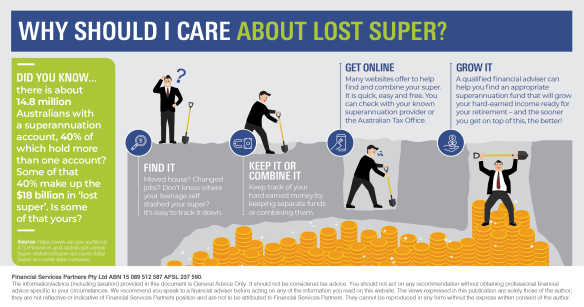
Lost Super stats
Did you know there is about 14.8 million Australians with a superannuation account? Around 40% hold more than one superannuation account? Some of that 40% makes up the $18 billion in ‘lost super’. Is some of that yours? Should you care about lost super?
Find it
Have you moved house since starting work? Changed jobs over the years? Don’t know or remember where your teenage self stashed your super? It’s easy to track it down. It’s time to care about your lost super.
Combine it
Combining your multiple accounts can help save on fees and reduce your paperwork. Having all your superannuation together in a single account means you can keep track of your hard earned money. Even further grow your retirement fund.
Get online
Many websites offer to help find and combine your super. It is quick, easy and free. You can check with your known superannuation provider or the Australian Tax Office.
Grow it
A qualified financial adviser can help you find an appropriate superannuation fund that will grow your hard-earned income ready for your retirement – and the sooner you get on top of this, the better! Give the team at Wealth Planning Partners a call if you’d like to grow your super.
Source: https://www.ato.gov.au/About-ATO/Research-and-statistics/In-detail/Super-statistics/Super-accounts-data/Super-accounts-data-overview/

by Amanda Cassar | Jun 5, 2018 | Finances
“Cancer isn’t always a matter of genetics or bad luck.” – Prof. David Whiteman, Brisbane’s QIMR Berghofer Medical Research Institute.1
A recent study from the institute found risky habits and behaviour are to blame for more than 16,000 Australians being diagnosed with cancer each year.2 The good news is that changing these behaviours may help prevent certain cancers forming.
The most common types of cancers that are directly related to lifestyle choices include skin melanomas; lung, bowel, liver and stomach cancers.3
The key culprits causing these types of cancers are pretty obvious to most of us, and include:
- smoking
- high intake of red & processed meats
- low fruits and vegetables
- excessive exposure to UV light
- excessive alcohol consumption
- physical inactivity
- overweight.4
You don’t need to be a genius to know it all boils down to what we put in our bodies and how often we move.
So, what changes can you make for a healthier lifestyle?
- The biggest cause of preventable cancer is smoking, so your first mission is to “hang tough, don’t puff!”5
- Eat more fruit and veg and reduce red and processed meat –going vegetarian just two days per week may help you create a more balanced diet. You might even be surprised at some of the tasty and creative options available minus the meat!
- Decrease the grog – limit drinks to special occasions, weekends or set yourself the challenging of nursing one to two drinks only at a party.
- Exercise regularly – exercise helps reduce risks of various physical and mental health problems.6 If you have a sedentary ‘sit on youb bum’ lifestyle, even committing to 15 minutes of walking a day could be a great start.
- Reduce exposure to UV light – get your rays early in the morning or late in the afternoon and use a combination of protective clothing, shade and sunscreen. The tan bed has got to go!
1-5 ABC News, (2017), ‘Changes to risk factors could have prevented 40 per cent of cancer deaths, study finds’. Available at: http://www.abc.net.au/news/2017-12-12/cancer-study-finds-40pc-deaths-preventable-with-lifestyle-change/9247876
6 Australian Government, Department of Health, ‘Physical Activity’. Available at: http://www.health.gov.au/internet/main/publishing.nsf/content/phy-activity
by Jodie | Jun 4, 2018 | Advisers, Budget, Finances, Money, Retirement, Savings, Superannuation, Taxation
The end of financial year doesn’t have to be too taxing a time. These five tips will help organise your finances for the coming financial year.
Take the pain out of EOFY by being organised. With the right preparation, you can make lodging your tax return a painless process and maybe even increase your refund!
Firstly…
1. Plan ahead
Decide when and how you will lodge your tax return. Will you do it online, via a lodgement service, the MyGov portal or ask your accountant? Your choice may depend on the complexity of your affairs but whichever option you choose, allocate time in advance. Often, it can be a great idea to meet with your adviser or accountant in June to ensure you are maximising the deductions and investments available before June 30. Don’t leave it to the last minute and find out you’ve missed out!
2. Find all you need
Often the most challenging part of lodging your tax return is finding all the relevant paperwork if you haven’t been of top of it all year. It can pay to keep your tax information together through the year, including receipts and bank and credit card statements. You’ll also need payment summaries, records of interest, details of any foreign pensions, your spouse’s income details and other records if you have investments or rental properties. You can see the complete list on the ATO website. If you’re not great at being overly organised, invest in a tray or spike that you can put all the relevant paperwork on as it comes in so that it’s handy when you need it each year.
3. Know your deductions
Many people don’t realise what you can claim tax deductions on. From dry-cleaning to charitable donations and superannuation contributions, knowing what expenses are tax-deductible may increase your tax refund significantly. Typical deductions include work-related training or courses, uniform costs, some insurances and office expenses.
The ATO website has a useful list of deductible expenses. If you want to get ahead, you could even purchase deductible items for next year before June 30 so they’re deductible against this year’s income. Again, it’s worth checking in with your accountant early to ensure you get it right.
4. Boost your super – and your spouse’s
By sacrificing some of your pre-tax salary throughout the financial year, you can increase your retirement savings but also reduce your taxable income. Salary sacrifice contributions are taxed at a maximum rate of 15%[1] which may be less than your marginal rate. Popping in a lump sum prior to June 30 also works for many – just make sure you get the type of contribution right!
Also, contributing to your spouse’s super will boost their super savings and you may be entitled to a tax offset if your spouse earns less than $13,800.
5. Get ready for the year ahead
The end of the financial year is a great opportunity to understand your finances. Usually, you have until October 31 to finalise a personal return. After lodging your return you should be well equipped to plan for the next financial year. Start thinking about how you can improve your budget or if you have the funds to invest.
Automating a small savings program can have small funds quickly add up.
By following these tips, speaking with a financial adviser or accountant and conducting your own research too, you should be ready to transition easily into the new financial year.
[1] Australian Taxation Office. Accessed at www.ato.gov.au/Individuals/Super/Growing-your-super/Adding-to-my-super/Salary-sacrificing-super/
by Jodie | May 25, 2018 | Business, Finances, Insurance & Protection
Starting a new business can be exciting but there’s a lot to think about and organise too.
Before you even begin, consider how prepared you are to make the difficult decisions, work those long hours required, face possible and ongoing financial constraints, lose a fair amount of sleep, turn grey and maybe confront failure confront failure.
If that doesn’t put you off, here’s some more tips before you get started!
Research
If you still have the drive to make a success of your business idea, start by talking with others who have gone down the same path and can help you figure out your next steps. Most will tell you it’s hard, but totally worth it, tho some have enjoyed the journey, they’re also happy to go back to being employees.
Be under no illusions, this is a complex process with many moving parts, and having a checklist will make things easier.
The Department of Industry, Innovation and Science offers a lot of help through its business.gov.au website, including a start your own business preliminary checklist.
The checklist recommends following these steps:
- choose your business structure and type
- apply for an Australian Business Number (ABN)
- register your business name and trademark
- protect your intellectual property
- understand the appropriate standards and codes of practice
- set up record- and account-keeping processes
- register a website name
- work out what taxes you need to register for
- find out the registration processes and licences you need
- consider your insurance needs
- buy or lease business premises.
Business plan
One essential ingredient of any new business venture is to draw up a business plan, which you will need to secure any financing. It will also provide direction and help keep you on track. A business plan can run over one page, to being a small novel.
Financing your idea and keeping track of when the money comes in and where it goes, is crucial to your success, so a good bookkeeper and/or accountant is vital.
Employment
If you intend to hire people, you will also need to be familiar with the relevant labour laws, superannuation rules, work health and safety obligations and tax laws. Information about pay and conditions is available from the Fair Work Ombudsman website. You will also need workers’ compensation and public liability insurance.
A financial adviser can assist you with some of these, but there’s a lot to think about before jumping in.
But if you do still want to go for it, good luck to you and many successes ahead. We’d love to be a part of your journey and assist many in small business to get ‘all their ducks in a row.’ We’d love to help you too!