by Jodie | Jun 12, 2018 | Money, Superannuation
Lost Super stats
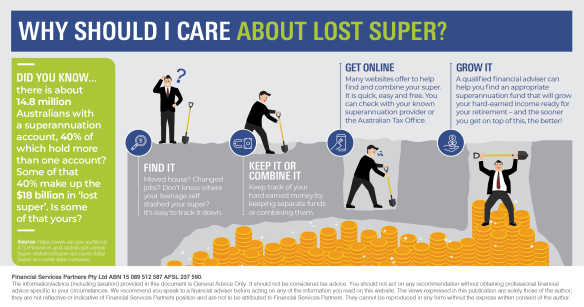
Did you know there is about 14.8 million Australians with a superannuation account? Around 40% hold more than one superannuation account? Some of that 40% makes up the $18 billion in ‘lost super’. Is some of that yours? Should you care about lost super?
Find it
Have you moved house since starting work? Changed jobs over the years? Don’t know or remember where your teenage self stashed your super? It’s easy to track it down. It’s time to care about your lost super.
Combine it
Combining your multiple accounts can help save on fees and reduce your paperwork. Having all your superannuation together in a single account means you can keep track of your hard earned money. Even further grow your retirement fund.
Get online
Many websites offer to help find and combine your super. It is quick, easy and free. You can check with your known superannuation provider or the Australian Tax Office.
Grow it
A qualified financial adviser can help you find an appropriate superannuation fund that will grow your hard-earned income ready for your retirement – and the sooner you get on top of this, the better! Give the team at Wealth Planning Partners a call if you’d like to grow your super.
Source: https://www.ato.gov.au/About-ATO/Research-and-statistics/In-detail/Super-statistics/Super-accounts-data/Super-accounts-data-overview/
by Jodie | Jun 4, 2018 | Advisers, Budget, Finances, Money, Retirement, Savings, Superannuation, Taxation
The end of financial year doesn’t have to be too taxing a time. These five tips will help organise your finances for the coming financial year.
Take the pain out of EOFY by being organised. With the right preparation, you can make lodging your tax return a painless process and maybe even increase your refund!
Firstly…
1. Plan ahead
Decide when and how you will lodge your tax return. Will you do it online, via a lodgement service, the MyGov portal or ask your accountant? Your choice may depend on the complexity of your affairs but whichever option you choose, allocate time in advance. Often, it can be a great idea to meet with your adviser or accountant in June to ensure you are maximising the deductions and investments available before June 30. Don’t leave it to the last minute and find out you’ve missed out!
2. Find all you need
Often the most challenging part of lodging your tax return is finding all the relevant paperwork if you haven’t been of top of it all year. It can pay to keep your tax information together through the year, including receipts and bank and credit card statements. You’ll also need payment summaries, records of interest, details of any foreign pensions, your spouse’s income details and other records if you have investments or rental properties. You can see the complete list on the ATO website. If you’re not great at being overly organised, invest in a tray or spike that you can put all the relevant paperwork on as it comes in so that it’s handy when you need it each year.
3. Know your deductions
Many people don’t realise what you can claim tax deductions on. From dry-cleaning to charitable donations and superannuation contributions, knowing what expenses are tax-deductible may increase your tax refund significantly. Typical deductions include work-related training or courses, uniform costs, some insurances and office expenses.
The ATO website has a useful list of deductible expenses. If you want to get ahead, you could even purchase deductible items for next year before June 30 so they’re deductible against this year’s income. Again, it’s worth checking in with your accountant early to ensure you get it right.
4. Boost your super – and your spouse’s
By sacrificing some of your pre-tax salary throughout the financial year, you can increase your retirement savings but also reduce your taxable income. Salary sacrifice contributions are taxed at a maximum rate of 15%[1] which may be less than your marginal rate. Popping in a lump sum prior to June 30 also works for many – just make sure you get the type of contribution right!
Also, contributing to your spouse’s super will boost their super savings and you may be entitled to a tax offset if your spouse earns less than $13,800.
5. Get ready for the year ahead
The end of the financial year is a great opportunity to understand your finances. Usually, you have until October 31 to finalise a personal return. After lodging your return you should be well equipped to plan for the next financial year. Start thinking about how you can improve your budget or if you have the funds to invest.
Automating a small savings program can have small funds quickly add up.
By following these tips, speaking with a financial adviser or accountant and conducting your own research too, you should be ready to transition easily into the new financial year.
[1] Australian Taxation Office. Accessed at www.ato.gov.au/Individuals/Super/Growing-your-super/Adding-to-my-super/Salary-sacrificing-super/
by Jodie | May 25, 2018 | Business, Finances, Insurance & Protection
Starting a new business can be exciting but there’s a lot to think about and organise too.
Before you even begin, consider how prepared you are to make the difficult decisions, work those long hours required, face possible and ongoing financial constraints, lose a fair amount of sleep, turn grey and maybe confront failure confront failure.
If that doesn’t put you off, here’s some more tips before you get started!
Research
If you still have the drive to make a success of your business idea, start by talking with others who have gone down the same path and can help you figure out your next steps. Most will tell you it’s hard, but totally worth it, tho some have enjoyed the journey, they’re also happy to go back to being employees.
Be under no illusions, this is a complex process with many moving parts, and having a checklist will make things easier.
The Department of Industry, Innovation and Science offers a lot of help through its business.gov.au website, including a start your own business preliminary checklist.
The checklist recommends following these steps:
- choose your business structure and type
- apply for an Australian Business Number (ABN)
- register your business name and trademark
- protect your intellectual property
- understand the appropriate standards and codes of practice
- set up record- and account-keeping processes
- register a website name
- work out what taxes you need to register for
- find out the registration processes and licences you need
- consider your insurance needs
- buy or lease business premises.
Business plan
One essential ingredient of any new business venture is to draw up a business plan, which you will need to secure any financing. It will also provide direction and help keep you on track. A business plan can run over one page, to being a small novel.
Financing your idea and keeping track of when the money comes in and where it goes, is crucial to your success, so a good bookkeeper and/or accountant is vital.
Employment
If you intend to hire people, you will also need to be familiar with the relevant labour laws, superannuation rules, work health and safety obligations and tax laws. Information about pay and conditions is available from the Fair Work Ombudsman website. You will also need workers’ compensation and public liability insurance.
A financial adviser can assist you with some of these, but there’s a lot to think about before jumping in.
But if you do still want to go for it, good luck to you and many successes ahead. We’d love to be a part of your journey and assist many in small business to get ‘all their ducks in a row.’ We’d love to help you too!

by Jodie | May 15, 2018 | Finances, Superannuation
Planning is the key to be retirement ready… and so is getting advice.
You can avoid penny pinching in retirement because you haven’t saved enough money, but you do need to plan well ahead.
Here’s two top tips you’ll need to consider.
1. Figure out how much you’ll need
Find out how much income you will need by answering the following three questions:
- What are your retirement goals?
- What kind of lifestyle do you want?
- What is your life expectancy?
While it’s fairly easy to set goals and lifestyle expectations for retirement, estimating how long you will live can be a bit more tricky, but is crucial to retirement planning decisions. It can help you decide on your risk profile, your personal asset allocation and even when to stop working to ensure you have enough funds for your retirement.
Although there are tools that you can use for calculating life expectancy, your financial adviser can help guide you through the process too. It could also depend on the longevity history in your family. Your adviser can help you come up with an estimate of your required retirement income based on your lifestyle expectations, tailored risk profile and how many years you’re likely to spend in retirement.
2. Ensure you’ll have enough income
With an estimate of how much you’ll need, your adviser can make recommendations to help you meet your required retirement income. These may include growing your retirement fund by investing some or all of it. It may also mean depositing more into superannuation or building wealth outside of super.
Investment products usually carry risks. It’s important that you choose instruments that suit your personal risk appetite and need for returns.
If you prefer to have a regular and stable flow of income in retirement, there are definitely options available for you.
Seek professional advice on how this can be done and how you can get appropriate outcomes. We’d love to help!

by Jodie | May 15, 2018 | Superannuation, Wealth
For many years, salary sacrifice has been the most tax-effective way to build superannuation.
New Super Strategies! Now, add personal deductible contributions to your super strategy.
New legislation introduced 1 July, 2017 removes restrictions on claiming a tax deduction for personal contributions to super. That is, if 10% or more of your total income is attributable to employment. So, from a tax and super viewpoint, personal deductible contributions will have the same net effect as salary sacrifice.
You can use either strategy to reduce your taxable income and boost super contributions. However, personal deductible contributions are taxed. For certain defined-benefit super funds, existing qualifications on these deductions remain. For example, you must give a notice of intent form to your super fund before:
- starting an income stream with all or part of the contribution
- withdrawing or rolling over benefits (including the contribution)
- giving the trustee a splitting contributions application.
In any other case, you must give a notice of intent form to your super fund when you lodge your tax return. Or at the end of the financial year following the year in which the contribution was made – whichever comes first.
You must be aged under 65 or satisfy the work test between 65 and 74. But, a contribution can be accepted within 28 days of the end of the month you turn 75.
Salary sacrifice has its drawbacks
While salary sacrifice has been the cornerstone strategy, it can have restrictions. For example, some employees do not offer it, or will not allow you to pick your own fund. There’s no guarantee about the frequency of contributions. If you have income replacement insurance, you might find this is affected by your reduced income through salary sacrifice. Your employer may even reduce your super guarantee entitlements to match this reduced income. It may be time to implement a new super strategy.
A comprehensive super strategy
Personal deductible contributions could be a great fit for your financial plan. You can choose your super fund and the timing of your contributions. And because you’re claiming a tax deduction on your super contribution – not reducing your salary – your income protection probably won’t be affected.
Personal deductible contributions can also work well alongside your transition to retirement strategy and other contributions you’re making. These include spouse contributions, co-contributions and contribution splitting.
It’s always a good idea to review your financial situation and savings plan before new legislation comes into place. Speak with a financial adviser to learn about how you could benefit from building personal deductible contributions into your retirement savings strategy.
The advisers at Wealth Planning Partners would be happy to help!